| The Great Mandala |
|
Words of Nichiren, from the "Ho'on Jo", enumerating the three great secret dharmas ("san dai hi ho"):
"The first is the object of worship (honzon). All the people in Japan as well as the rest of the whole world should revere the Lord Buddha Shayamuni (Original and eternal Buddha) revealed in the essential section (honmon) of the Lotus Sutra as the object of worship (honzon). That is to say, the object worshiped should be the Buddha Shakyamuni and Taho Buddha in the Stupa of Treasures. The other Buddhas standing outside the Stupa and the four bodhisattvas such as Jogyo should be their attendants." 1. The Analysis of the word Gohonzon Go is an honorific prefix that can be dispensed with. Hon means, "root, fundamental, original, primary, or supreme." Son or zon means, "honorable or venerable." Thus honzon means, "the Most Venerable One," or "the object of worship." However, the term "the object of worship" is too apathetic and emotionless an expression to apply to the Gohonzon, which we worship as the Most Venerable One in the world. 2. The Gohonzon of Nichiren Buddhism
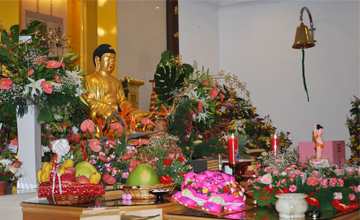
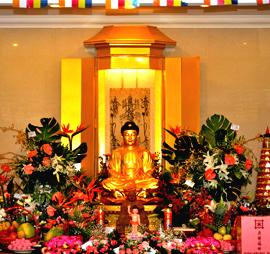
The Historical Sâkyamuni Buddha is no other than the Original Buddha. He says in the Lotus Sûtra (ibid., p.241), "The gods, men and asura in the world think that I left the palace of the Sakyas, sat at the place of enlightenment not far from the City of Gaya, and attained Anuttara-samyak-sambodhi forty and some years ago. To tell the truth, it is many... billions of kalpas since I became the Buddha." The Original Buddha is named Sâkyamuni because the Historical Buddha had no name other than Sâkyamuni. The Original Sâkyamuni Buddha is eternal. He says in the Lotus Sûtra (p. 246), "1 shall never pass away. I always live here and expound the Dharma." He remains eternal to save us. The definition of the Buddha as eternal is more preferable to us who seek his salvation. 3. The Statue of the Eternal Sâkyamuni Buddha
4. The Imagery of the Lotus Sûtra
The other-worldly narration of the Lotus Sûtra begins with the story of Prabhutaratna (Many-Treasures, Taho) Buddha, as follows: "There lived a Buddha called Taho many kalpas ago in a world called Treasure-Pure, which was located far to the east of the Saha World. Taho Buddha knew the Wonderful Dharma, but did not expound it by himself. He thought that the Wonderful Dharma should be expounded by a Buddha who would emanate from himself as many Replica-Buddhas as there are worlds in the universe, dispatch them to those worlds, and then expound the Wonderful Dharma in a sûtra called the Lotus Sûtra. Taho Buddha decided to wait for the advent of such a Buddha, and to approve the truthfulness of the Lotus Sûtra expounded by that Buddha. Taho Buddha requested his disciples to build a Stûpa, and to put his body in it after he passes away. His disciples made a Stûpa as they were instructed. After his Parinirvâna, they positioned his body into a sitting posture of meditation, put it in the Stûpa, and shut the door. A Buddha can see, hear, speak, and even move after his Parinirvâna. The only thing a past Buddha cannot do is to expound the Dharma. He must be satisfied with hearing the Dharma expounded by a present Buddha. Taho Buddha had been watching all the corners of the universe for many kalpas until he finally found a Buddha doing what He had wished to see. He saw Sâkyamuni Buddha of the Saha World, which was located far to the west of his world, issue many replicas from himself, dispatch them to all the worlds of the universe, and then expound the Lotus Sûtra. Having rejoiced at seeing all this, Taho Buddha prepared himself for the journey to the Saha World. He made his Stûpa move. It flew through the skies over many worlds, and reached the sky below the Saha World. Then the Stûpa rose, passed the Saha World from underneath, and floated in the sky above Mt. Sacred Eagle. Taho Buddha turned the Stûpa toward Sâkyamuni, and praised him from within the Stûpa. The congregation was astonished to see all this. Representing the congregation, Daigyosetsu Bodhisattva asked Sâkyamuni, "Who is in the Stûpa?" Sâkyamuni answered, "Taho Buddha is there." Daigyosetsu begged Sâkyamuni to open the door of the Stûpa so that all the congregation could see the newly arrived Buddha. But Sâkyamuni refused his appeal, saying that Taho Buddha would never allow anyone to open the door of his Stûpa unless an expounder of the Lotus Sûtra collects his Replica Buddhas from the worlds of the ten quarters. Daigyosetsu begged Sâkyamuni to collect them. Sâkyamuni Buddha consented to his appeal. He issued a ray of light from his forehead as a sign to call them forth. Acknowledging this light, the Buddhas of the worlds of the ten quarters returned to their home world, and assembled on Mt. Sacred Eagle. With this Sâkyamuni Buddha hovered, and opened the door of the Stûpa. Taho Buddha moved to the left to make some space for Sâkyamuni to sit, and asked him to join him. Sâkyamuni entered the Stûpa and sat on the right of Taho Buddha. Seeing the two Buddhas sitting side by side in the Stûpa hanging in the sky, the congregation wished to be near the two Buddhas. Reading the minds of the congregation. Sâkyamuni raised them up to the sky below the Stûpa. Thereupon Sâkyamuni Buddha announced that he would transmit the Lotus Sûtra to someone. Hearing this, many Bodhisattvas begged Sâkyamuni to transmit it to them. But he refused their appeal, saying, "I meant to say that I would transmit this sûtra to someone other than you. You are not needed. I have chosen the ones to whom I will transmit this sûtra." When he said this, innumerable Bodhisattvas sprang up from the four comers of the Saha World. The four army-like divisions of Bodhisattvas were headed by one or another of the Four Bodhisattvas: Visistacâritra (Jogyo), Anantacâritra. (Muhengyo), Visuddhacâritra (Jogyo) and Spratisthitacâritra. (Anryugyo). All the Bodhisattvas from underground rose to the sky, and greeted Sâkyamuni Buddha with the disciple-to-master courtesy, saying, "We are very glad to see you again. Are you in good health?" Sâkyamuni said to them, "I am very glad to see that you rejoice at seeing me again." The congregation was surprised to see the newcomers from underground greeting Sâkyamuni as respectfully and as courteously as if they were the disciples of Sâkyamuni Buddha. Representing the congregation, Maitreya Bodhisattva asked Sâkyamuni, saying, "Who are they? We have never seen them before. They must have hidden themselves underground a very long time ago. You are younger than they because it is only forty and some years ago that you became the Buddha. But these elders greet you as respectfully and as courteously as if they were your disciples. This is strange. It is difficult to believe that a handsome, black-haired man of twenty-five years can point to men a hundred years old, and say, 'They are my sons.' Who are the newcomers?" Sâkyamuni Buddha said to Maitreya Bodhisattva, "You think that I left the palace of the Sakyas, sat at the place of enlightenment, and became the Buddha forty and some years ago. You are mistaken. I became the Buddha in the remotest past. These Bodhisattvas from underground are my disciples whom I taught in the remotest past." After saying this, Sâkyamuni Buddha transmitted the Lotus Sûtra to the Bodhisattvas headed by Visistacâritra. Then he descended from the Stûpa to the ground. All the people who were in the sky also descended. Sâkyamuni Buddha put his right hand on the heads of the Bodhisattvas, and said, "Now I will transmit the Lotus Sûtra to all of you. Propagate it with all your hearts."
5. Nichiren's Description of the Purified Saha World
There is a Stûpa of treasures in the sky above the Saha World of the Original Teacher. The Stûpa of treasures enshrines the Myôhô Renge Kyô. On either side of the Myôhô Renge Kyô sit Sâkyamuni Buddha and Prabhutaratna Buddha. The Four Bodhisattvas headed by Visistacâritra accompany Sâkyamuni, the World-Honoured One. The four Bodhisattvas including Mañjusri and Maitreya sit on lower seats as the attendants of Sâkyamuni Buddha. All the other Bodhisattvas, major or minor, who are either the disciples of the Historical Sâkyamuni or the Bodhisattvas having come from other worlds, are like nobles and dignitaries who are respected by their subjects sitting on the ground. The Buddhas of the ten quarters sit on the ground to show that they are emanations of Sâkyamuni Buddha and that their worlds are reflections of the world of Sâkyamuni Buddha. 6. The Mandala
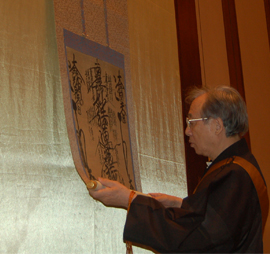
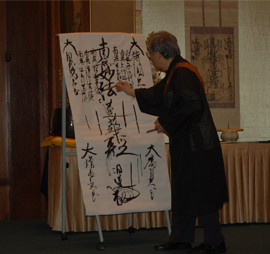
According to Nichiren's perspective of the Purified Saha World given in the Kanjin-honzon-shô, all the Bodhisattvas attend Sâkyamuni Buddha, none accompanies Prabhutaratna. To maintain the balance of the Mandala, Nichiren moved some Bodhisattvas from the left to the right column as though they were the attendants of Prabhutaratna. Nichiren added living beings to the Mandala as representatives of the inhabitants of the Purified Saha World: 1. Theravada Buddhist saints such as Sâriputra and Mahâ-Kâsyapa, who are assured of future Buddhahood in the Lotus Sûtra. 2. Cakravartiraja (Wheel-turning-holy-king, Tenrin-jo-o) and King Ajatasatru as the representatives of laymen. 3. Devadatta, once a disciple of Sâkyamuni Buddha. He later became an apostate, was assured of future Buddhahood in the Lotus Sûtra. 4. Noted propagators of the Lotus Sûtra: Nagarjuna of India, Tendai Daishi and Myôraku Daishi of China, and Dengyo Daishi of Japan. 5. Gods and demigods: Brahman, Mara, Sâkra, the Heavenly Kings of the Four Quarters (Shitenno), Surya, Cândra, Aruna, Asuraraja, Nagaraja, Hariti and the ten female raksasa of India, Tensho Daijin and Hachiman Daibosatsu of Japan. 6. Two esoteric deities: Acalanatha (Fudo) and Ragaraja (Aizen) in the form of their Sanskrit symbols. 7. The O’mandara Gohonzon
1. The Japanese feel it impolite to refer to someone ranked higher or something regarded as sacred by one's name directly. Instead, the name of one's residence or the locality of one's abode is used. Dono, an honorific suffix attached to a personal name, primarily meant "mansion." The "Imperial Palace," for example, implies the Emperor. Similarly, the Mandala is called Gohonzon in place of the Eternal Buddha. 2. When Nichiren described the Purified Saha World in the Kanjin-honzon-shô, he positioned the Daimoku between the two Buddhas as the symbol of the Purified Saha World. Symbolism was very important during Nichiren's day. Various warring families were distinguished by their particular crests, flags and banners. Nichiren thought that the Daimoku was the best symbol to characterize Nichiren Buddhism while all the other sects were more or less connected with the Nembutsu. However, the Daimoku written in the center of the Mandala appears so gigantic and powerful that it overwhelms the surrounding beings. Even Sâkyamuni Buddha is overshadowed by the Daimoku. This arrangement of the Mandala gave rise to the worship of the Daimoku as the Gohonzon. Some held that all the Buddhas including Sâkyamuni, Bodhisattvas and other dignitaries as well as the gods and demigods inscribed in the Mandala, are the attendants of the Daimoku. This view was supported by the Japanese people who were fundamentally polytheistic. 3. The Mandala written on a piece of paper is fragile, easily worn out and torn. A more enduring material was necessary to maintain the Mandala. Therefore, wooden or metal statues were promoted in place of the Mandala. Idolization was promoted for another reason, In order to recover the dignity of the Original and Eternal Sâkyamuni Buddha, which was overshadowed by the Daimoku in the Mandala, a set of the statues, one-Buddha-four-Bodhisattvas, was recommended for worship. The frontier spirit of Nichiren, however, lies in the Mandala. Because the Mandala can be written anywhere, impromptu, it is suitable at the front of the Daimoku-chanting campaign. The Daimoku by itself can stand as the Gohonzon. There exists the term Ippen-shudai-no-honzon, which means the "Gohonzon of the Daimoku Only." The Daimoku is the symbol of all the Three Treasures of Nichiren Buddhism: • The Original and Eternal Sâkyamuni Buddha in One with the Historical Sâkyamuni Buddha. • The Wonderful Dharma of the Equality of All Living Beings, and • The Samgha headed by Visistacâritra Bodhisattva, the First and Foremost Disciple of the Original Sâkyamuni Buddha. When one sees the Daimoku inscribed on a flag, or a banner, or a stone monument, therein one can see the Buddha at once, and receive the protection of His messenger, Nichiren Shonin, the reincarnation of Visistacâritra Bodhisattva, Jogyo Bosatsu. Read more on Explanation Of Mandala. |