
The Map of the Lotus Sutra
By Rev. Shingyo Imai
Before we are going to take that first step and I want to do something a mountain guide does before leading a group into these wonderful mountains: unfold a map and look at the whole range from above. If you only ever look at the mountain directly in front of you, it's easy to lose track of where you are and where the path is actually going. But if you first see the whole range from a height, like a bird view — where the low passes are, where the great peaks rise, how the far side connects back to the near side — then every step you take afterward carries more meaning. That is what I want to give you this morning: not the details of any one chapter yet, but the shape of the whole map of the sutra, so that everything we read in the future months ahead has somewhere to belong.
The first thing to understand is a division that Tiantai masters, and later our founder Nichiren Shonin, considered the single most important structural key to the entire sutra: the distinction between the "Trace Teaching," (迹門), and the "Origin Teaching," (本門).
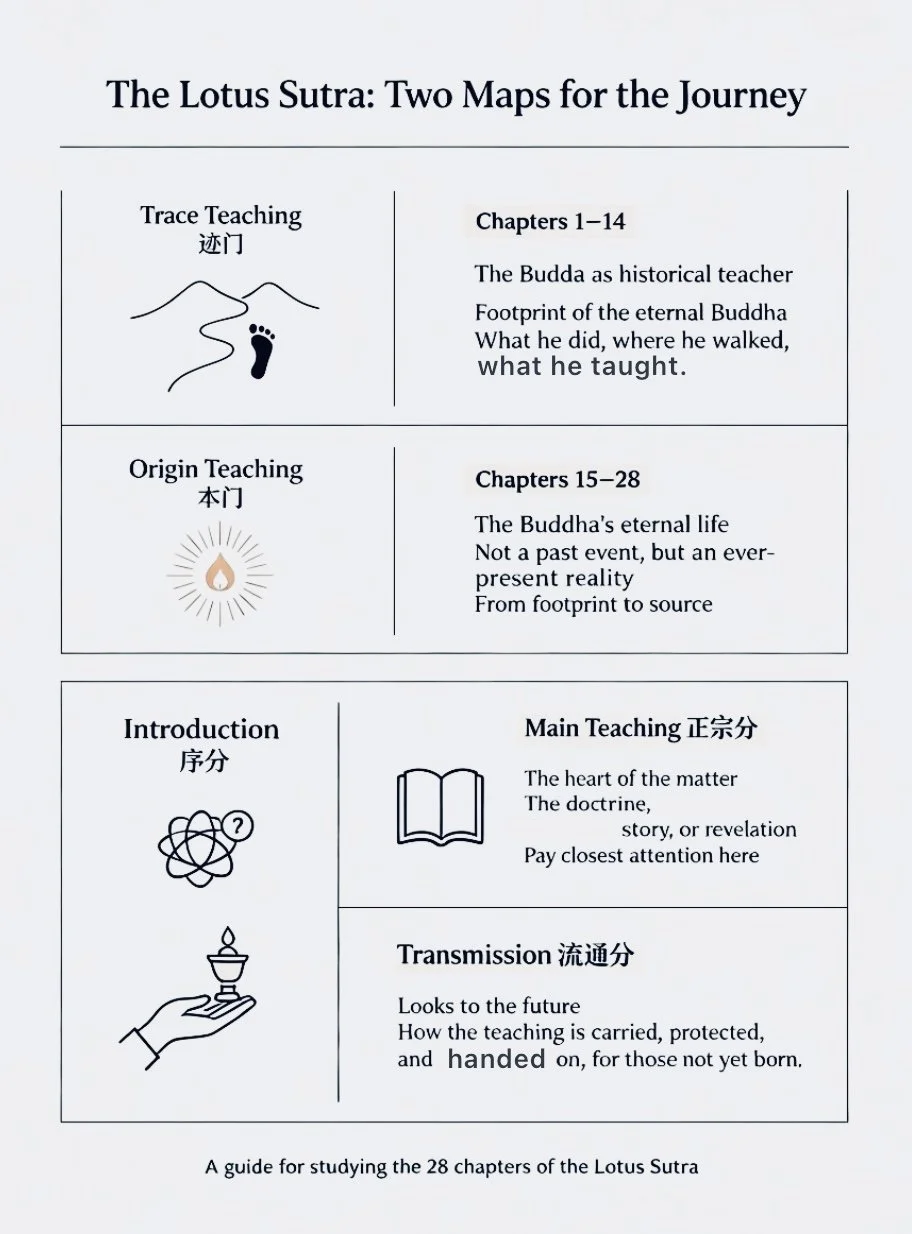
(The first map: Trace Teaching and Origin Teaching)
The first half of the sutra — Chapter 1, the Introduction, through Chapter 14, "Peaceful Practices" — is the Trace Teaching. Here, the Buddha appears the way most of us already picture him: a human being who, twenty-five hundred years ago, sat down beneath the Bodhi tree in northern India and, for the first time, was awakened. In this half of the sutra he teaches as that figure — the son of King Suddhodana, the ascetic Gautama Siddhartha, the teacher who spent decades using countless skillful methods, countless parables, to lead very different kinds of listeners toward the truth. The word "trace" here means something like footprint. A footprint is real — it truly was left by someone walking — but it is not the person. It is evidence of them, in one place, at one moment. The Trace Teaching is the footprint of the eternal Buddha, pressed into history at Buddha Gaya twenty-five hundred years ago.
Then comes the second half — Chapter 15, "Emerging from the Earth," through Chapter 28, the final chapter — and here something extraordinary happens. In Chapter 16, called "The Duration of the Life of the Tathagata," the Buddha turns to the assembly and tells them the truth behind the footprint. He did not, he says, first awaken twenty-five hundred years ago at all. That awakening under the Bodhi tree was itself a kind of skillful appearance. In reality, he says, he attained Buddhahood in a past so unimaginably distant that ordinary numbers cannot measure it — a span of time the sutra can only gesture toward through images of grinding whole worlds into dust and counting the specks. This is the Origin Teaching: the revelation, not of what the Buddha did on one particular afternoon in India, but of what the Buddha is — an eternal, ever-present life that has never actually stopped teaching, never actually entered final extinction, and is, even now, closer than we imagine.
So here is the movement of the whole sutra, in one sentence: in the Trace Teaching we come to know the Buddha's activity in the world — what he did, where he walked, whom he taught, and how. In the Origin Teaching we meet the Buddha's life itself — not an event in the past, but a presence that has always been and always will be. From footprint to source. From what he did to who he is. Every single chapter we read together, from now until we close the book, will belong to one side of that great arc or the other, and knowing which side you're standing in will help everything make sense.
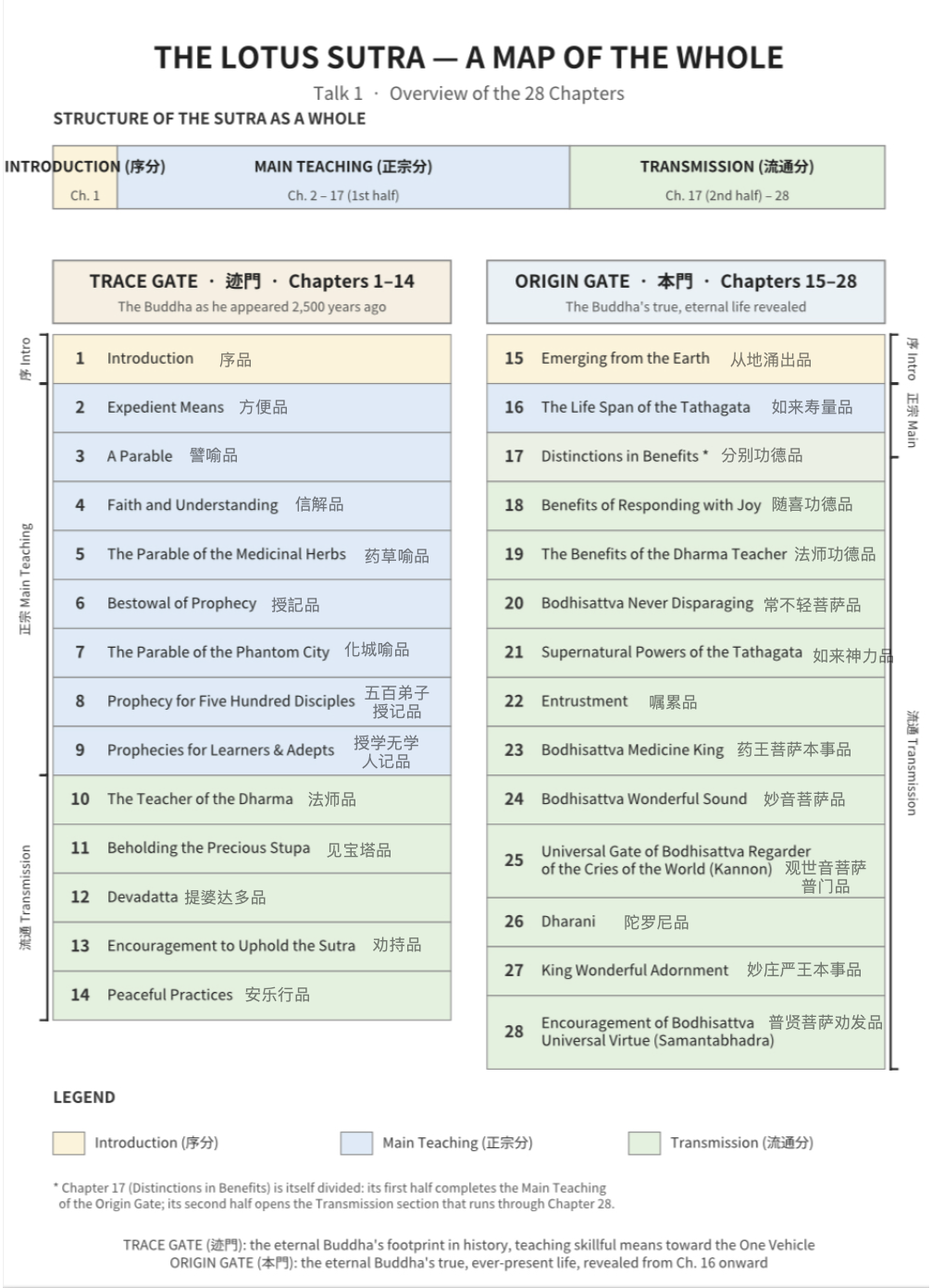
(The second map: Introduction, Main Teaching, Transmission)
The second map is smaller in scale but just as useful, and it applies twice over — once to the sutra as a whole, and again to nearly every individual chapter within it. It is the three-part structure that early commentators, and Tiantai in particular, used to organize any sutra: the Introduction, (序分); the Main Teaching, (正宗分); and the Transmission, (流通分).
The Introduction sets the stage — who has gathered, where, under what circumstances, and what sign or wonder signals that something important is about to be revealed. The Main Teaching is the heart of the matter: the actual doctrine, story, or revelation that the chapter exists to deliver. And the Transmission looks forward — now that this has been heard, how it is to be carried, protected, and handed on to those who were not yet born to hear it themselves.
I want you to hold onto this structure loosely as we go, chapter by chapter. When a chapter opens with description and gathering, you are in the Introduction. When the teaching itself begins to unfold, you are in the Main Teaching — pay closest attention here. And when the chapter turns toward the future, toward vows and instructions for carrying the teaching onward, you are in the Transmission. Knowing which section you are standing in will keep you oriented.
(Why this matters — the story underneath the structure)
Now, you might reasonably ask: why do we have to lay out all this architecture before we've even read a single line? Because I don't want you to mistake the Lotus Sutra for a collection of separate teachings, loosely bound together. It is not that. It is one huge story. And it is, at its heart, a story about a parent and children who have wandered far from home. You will meet this story again and again in the chapters ahead, told in different shapes — a father searching for a son who has forgotten he is a son at all; a physician whose children have poisoned themselves and no longer trust the medicine that would save them; travelers on a long, exhausting road who need a resting place made them aware of just short of their true destination so they don't give up. Each parable wears different clothes. But underneath every one of them is the same single wish, stated plainly: that not one person be left behind, and that everyone — without exception — be led all the way to the same place the Buddha himself has already reached.
That is the feeling I want you to carry out of this room today, more than any doctrinal term: the sense that underneath all twenty-eight chapters runs one deep assurance — that there is a home to return to, that you have never actually been forgotten, and that none of us is walking this road alone.
Next Sunday, we begin at the true beginning: Chapter 1, the Introduction. Please carry this map with you in your mind.
Thank you for sharing. Namu Myoho Renge Kyo.